China’s rise in the world of biotech and pharma has been a central topic of discussion for a few years now. It was a laggard in the field around a decade ago, but has since rapidly reoriented.
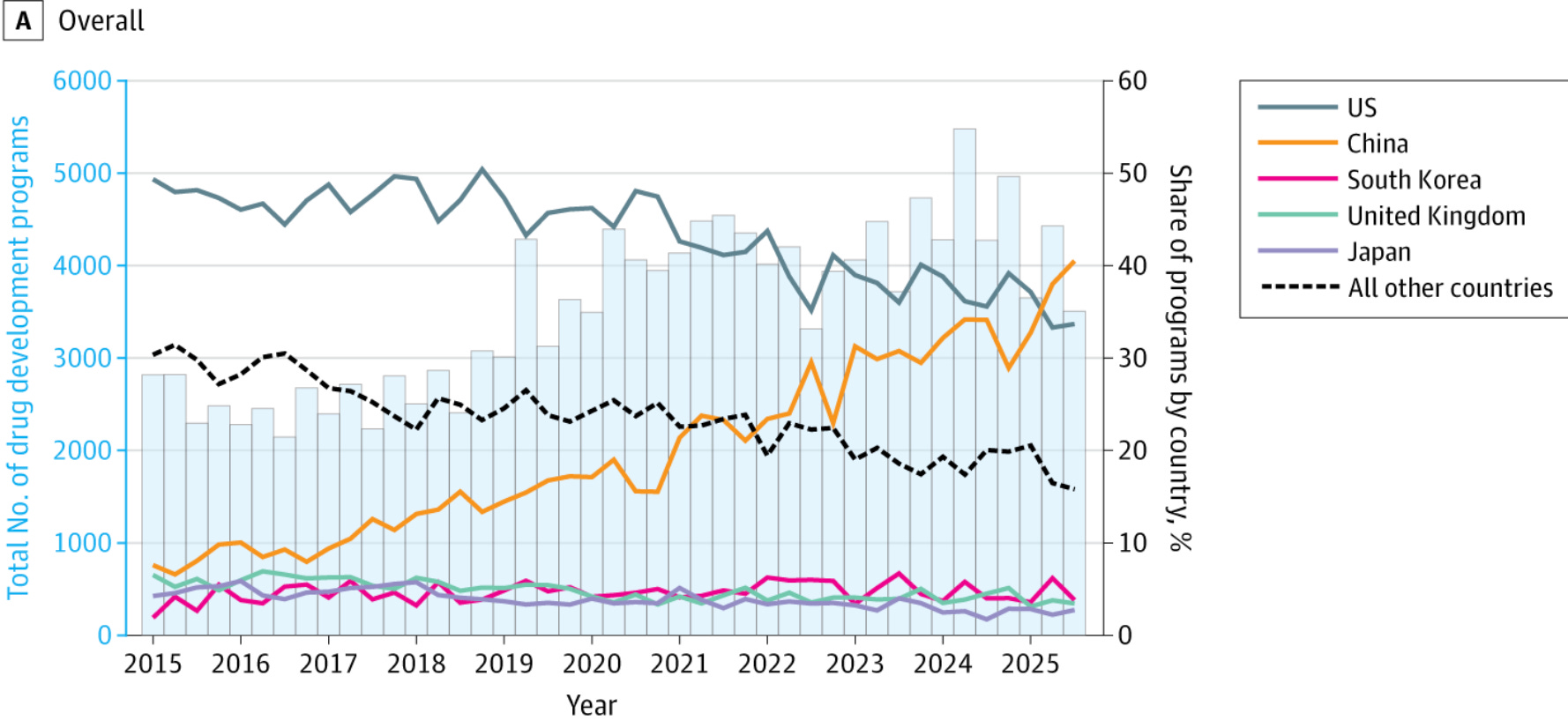
China now accounts for more early-stage clinical drug development programs than the United States and has become a major source of drugs licensed to US companies. There were likely several structural reasons for this – including cheaper manufacturing costs, lower patient costs, lower wages, and simply having a larger population – but another key difference was China’s approach to early-stage clinical trials.
Number of drug development programs (covering discovery to phase two clinical trials), in each region. Source: So-Yeon Kang and Yunan Ji (2026).
Early-stage clinical trials in the United States versus China
In the United States, drug developers face a long pathway before they’re able to start testing a new drug in clinical trials at all, including for a handful of patients; briefly, the pathway involves conducting preclinical safety studies, developing and documenting the manufacturing process and quality controls, preparing a trial protocol, submitting an Investigational New Drug application (IND) to the FDA, and obtaining institutional review board approval and agreements with trial sites.
In contrast, in China, the ‘investigator-initiated trial’ (IIT) pathway allowed researchers at hospitals to start testing drugs in small clinical trials after just a local scientific and ethics review, without first getting clearance from the national drug regulator. It also had less demanding documentation requirements for manufacturing and preclinical testing.
The upsides were that it was easier and faster for researchers to learn from ‘first-in-human’ trials in China. This is the first time new drugs are tested in people at all, and it can tell us if experimental drugs result in early signs of improvement, as well as help to understand how long the drug lasts in the body, whether it reaches the right organs, and whether it has noticeable effects on other biomarkers. Until then, researchers rely on lab and animal studies, which can be a poor predictor of what happens in people, because of the complexity of the human body as well as the (sometimes subtle, sometimes large) differences between us and animals in a lab.
When the process is cheaper and easier, it also seems likely that companies would increase their risk appetite, becoming more willing to test new approaches that may not succeed. That seems consistent with the fact that China tests more emerging technologies than the US does, including circular RNA, CAR-T and CAR-M therapies.
But it also came with downsides. Obviously, experimentation is inherently risky (both in terms of whether drugs will have any efficacy and whether they’ll potentially cause harmful side effects), but China’s system was also more opaque. China relied heavily on individual hospitals for oversight on ethics review, safety reporting, and manufacturing quality; and the country has only legally required researchers to disclose trial information publicly, update records when trials were completed or stopped early, and share completed reports with peers, since 2024, so important outcomes have been undisclosed.
Much of that came to the fore when Science, Retraction Watch and STAT published reports in July and August this year of deaths in gene therapy trials that took place in China last year, which hadn’t been publicly disclosed. The treatments involved using adeno-associated viruses (AAVs) to deliver CRISPR, a gene editing tool, to treat certain rare diseases. Adeno-associated viruses are commonly used to deliver gene therapies, but carry known risks of serious immune reactions and organ damage. It seems that the researchers had also overlooked earlier warning signs in animal studies in one of the trials.
Science and Retraction Watch’s story, reporting on a child’s death in a gene-editing trial in China in 2025. Source: Science magazine.
China’s crackdown on early stage clinical trials
In May, the Chinese government implemented tighter regulations on IITs, as part of ‘Order 818’, which may have resulted from their awareness of the deaths. The order meant the investigator led trials can now only take place in top-tier hospitals; it also required central filing and assessment by the National Health Commission; strengthened requirements for safety monitoring, reporting, and suspending studies after serious side effects; and tightened manufacturing requirements, including requiring compliance with Good Manufacturing Practice standards and product testing by third parties.
According to STAT, the deaths were known to Chinese regulators before the reporting, but public awareness seems to have prompted a much harsher reaction. They also reported a sharp slowdown in IITs in China, particularly gene therapies for rare diseases, though it’s unclear how widely the rules are being applied. Some people they spoke to believed there was a blanket ban on running IITs, while others were still planning trials. But since May, only 164 studies (out of over 1,000 submitted) had been approved under the new rules, including just two listed as gene therapy or gene-editing programs for rare genetic diseases.
Clinical trial efficiency doesn’t mean trading rigor for speed
People sometimes describe the Chinese systems as coming with trade-offs: faster trials that come with safety risks, and perhaps that’s a price worth paying. But in my opinion, learning about safety and failures also has value, beyond an immediate utilitarian calculation of how many lives are directly saved – they are useful information that help improve and refine treatments going forward. While parts of China’s approach, involving more iterative early testing, were useful, its lack of transparency and safety reporting was a problem.
I think it’s a genuine strength of the US approach that side effects and safety issues are made public, that there’s independent monitoring, and that trial registration has been required for decades. These are important not just in the abstract, but because they help other researchers learn from success and failure. Without pressure for that information to be made public, the wider scientific community learns less about what doesn’t work and why, and failures get repeated unnecessarily, especially since there’s otherwise a tendency to downplay failures and hype success.
To me, clinical trial abundance is not ‘speeding up trials’ per se, but a focus on making it faster to generate evidence. That is, the question is how to generate the same amount of evidence faster; or better, how to generate more evidence faster. It’s about operational efficiency rather than cutting corners, and there’s little point if the evidence that’s generated isn’t actually shared.
I think we can often find win-win solutions that improve both rigor and speed. Some obvious examples are by making it easier to recruit participants and increase the sample size of clinical trials or use platform trials, which can be more statistically and operationally efficient than separately run trials and help us learn how drugs compare to one another directly.
Australia as a model for early-stage trials
Even when it comes to the early-stage clinical trial system, there’s another country we can look towards, which takes the best of both approaches – Australia.
My co-bloggers Ruxandra and Adam have written about this at length for IFP and on this blog, and much of what I’ve learned about this is from them, but here are a few points to briefly summarize:
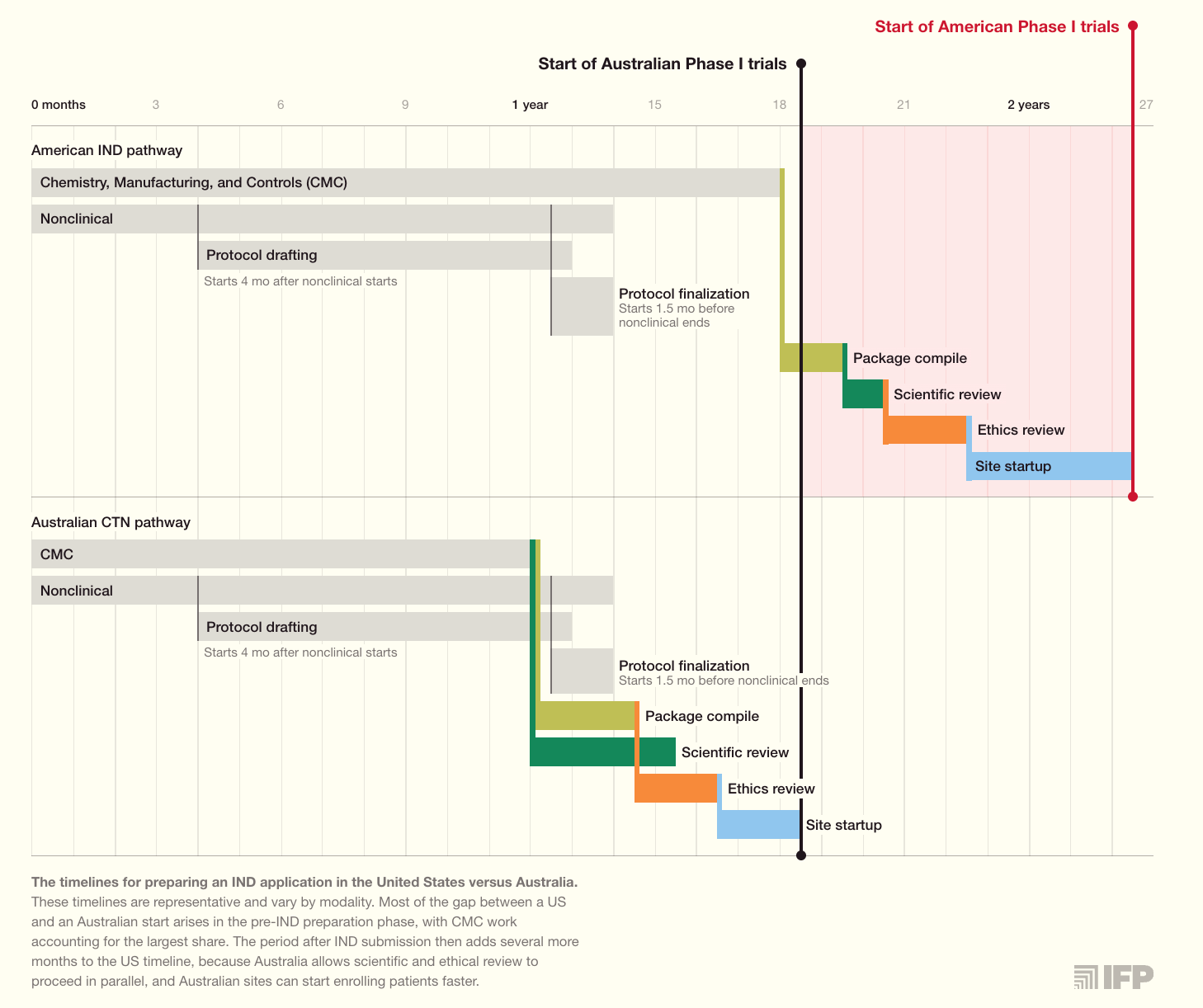
In the US, the FDA decides whether a phase one trial can proceed, while in Australia’s clinical trial notification pathway, this is left to independent ethics committees and the institutions hosting the trials.
Drug developers in the US generally get only one formal meeting with the FDA before submitting their application to start a phase one trial, while Australian committees can meet with them weekly, which helps them learn more precisely what to include. FDA reviewers typically ask for months of stability testing for the drug, even if it is only used for hours, days or weeks, while Australia asks for testing that covers the dosing period.
Source: Why Biotech Companies Go to Australia to Test New Drugs, IFP.
Australia also accepts research-grade components for the laboratory tests in an application, rather than pushing developers toward using commercial-grade components, as the FDA tends to do. Australian developers can also submit different components as they become ready, rather than waiting to compile everything at once.
And while US applications normally face a 30-day FDA review period before the trial can proceed, Australia’s notification pathway does not. All that results in a more streamlined process that’s, in my view, more reasonable, predictable and, on average, several months shorter.
Australia has been running trials this way since the 1990s, and is also a popular destination for biotech and pharma companies who want to run early-stage trials. Australia’s faster process still has strong requirements to monitor and report safety issues, including requirements to report urgent safety issues within 72 hours (or 15 days for other important safety issues), and the national regulator can inspect or stop trials.
In other words, iteration is easier because of proportional requirements, more frequent meetings with ethics committees, and a streamlined application process, rather than a ‘let it loose’ approach. I think there’s a lot we can learn from that.
Thanks for reading The Clinical Trials Abundance blog! Feel free to share this post or subscribe.