

Google Maps was launched in 2005. It is hard to imagine life before that little blue dot. You either memorised your daily routes (which were not necessarily optimal) or traced a new route on a map, which sometimes resulted in driving your caravan down a cobbled French street narrower than a baguette.
Navigation is hard, and it gets harder as the number of transport options grows. When your only option was to walk, journeys were slow but decisions were simple. But then came planes, trains, and automobiles. Each fantastic on its own, each emerging independently, and each adding complexity to the question of how to get from A to B. With a dozen possible modes for a single journey, choosing the best route becomes difficult. More options should mean faster journeys, but paradoxically, without a little help, more options can mean worse decisions.
The same thing is happening with regulatory reliance routes for medicines and vaccines. Since the WHO’s Prequalification programme was first introduced in the 1980s to help ensure new vaccines (and later medicines) met global standards, a growing number of international reliance pathways have emerged, including EU-M4all, FDA tentative approval, and Swissmedic’s MAGHP. They differ in who can use them, what they produce, and where the result is recognised. FDA tentative approval, for instance, exists so that PEPFAR can buy antiretrovirals that meet full FDA standards but cannot be sold in the US because of patents or exclusivity. EU-M4all is broader in scope but yields a scientific opinion rather than an authorisation, drawn up by the European Medicines Agency’s expert committee together with the WHO and regulators from the countries that will use the medicine. Swissmedic’s MAGHP goes a step further by providing a full Swiss authorisation, assessed jointly with regulators from participating African countries, who are then expected to grant their own approvals within 90 days.
Reliance pathways are wonderful. However, navigating them without a map can lead to poor choices, which have real consequences. Imagine a new treatment for a childhood infection. Submitted through one pathway, it might reach a handful of countries quickly but stall elsewhere because other national regulators don’t recognise that approval. Submitted through another, it might qualify for WHO Prequalification and donor procurement, unlocking access across dozens of countries at once, but only after a longer review. Neither route is wrong in the abstract; the right choice depends on where the patients are, who will buy the medicine, and how fast it’s needed.
That is why I built an interactive tool called ‘Reliance Pathways for Approving Medicines in LMICs’. It is intended to help navigate regulatory reliance pathways available for priority medicines and vaccines intended for low- and middle-income countries. I hope it is useful both to people trying to use the system well, such as drug developers and funders choosing a route for a product, and to people trying to improve it, such as researchers, policymakers, and regulators.
For a given medicine or vaccine, it shows every international reliance pathway available and helps identify the best route to approval by the National Medicines Regulatory Authority (NMRA) in a particular country.
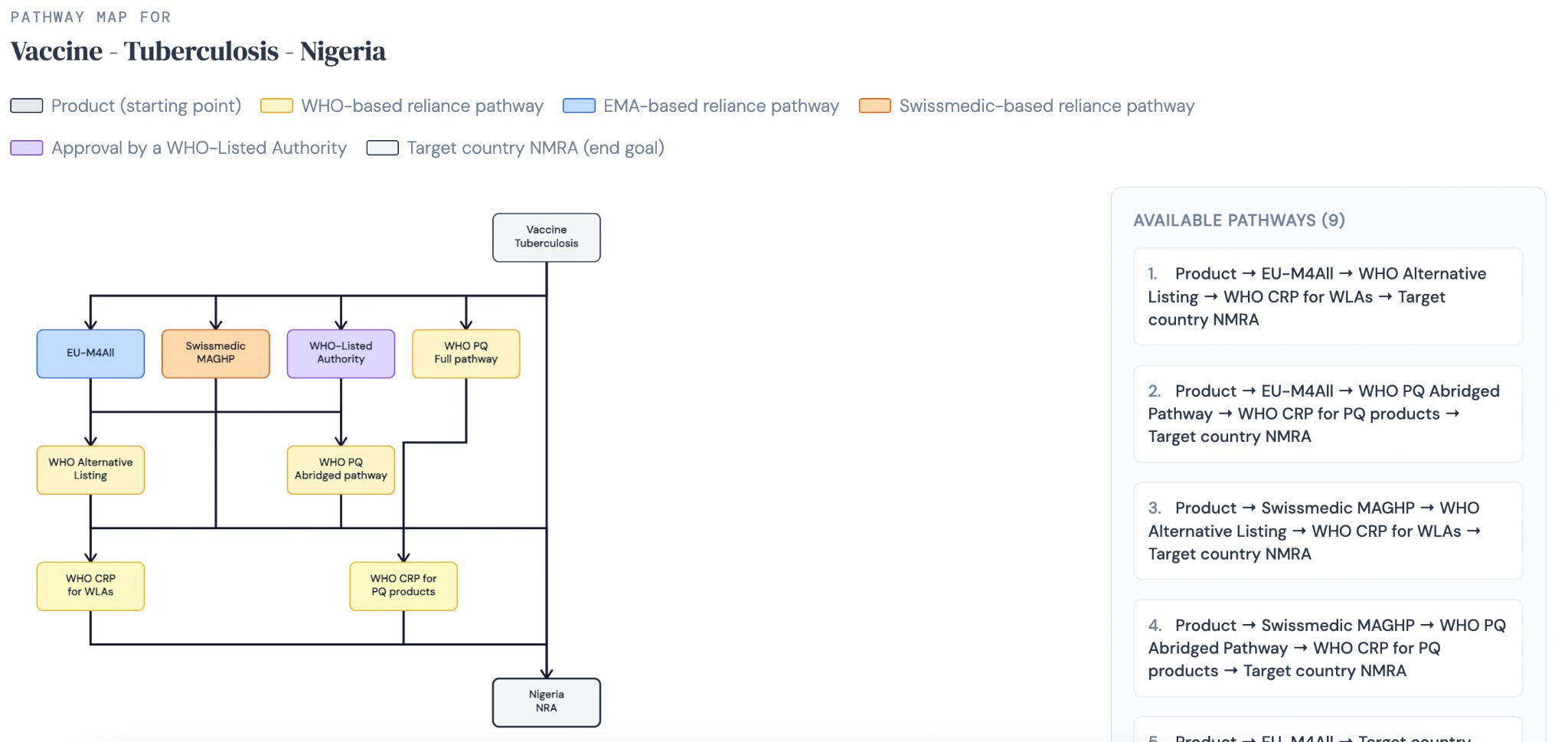
For example, if you select Vaccine (Medicine Type) > Tuberculosis (Disease/Indication)>Nigeria(Target Country)

the tool shows there are nine possible pathways
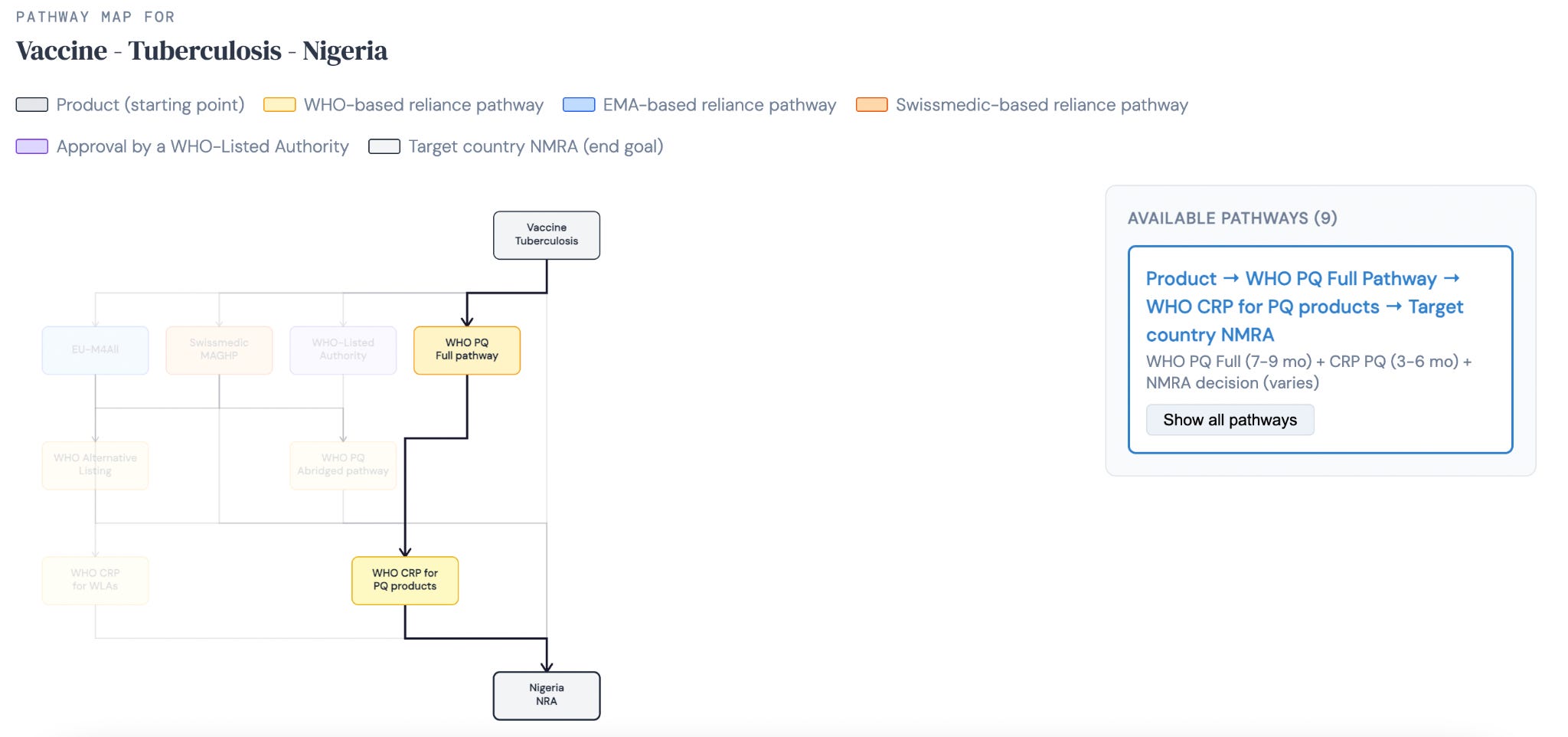
which you can explore individually by selecting any particular pathway
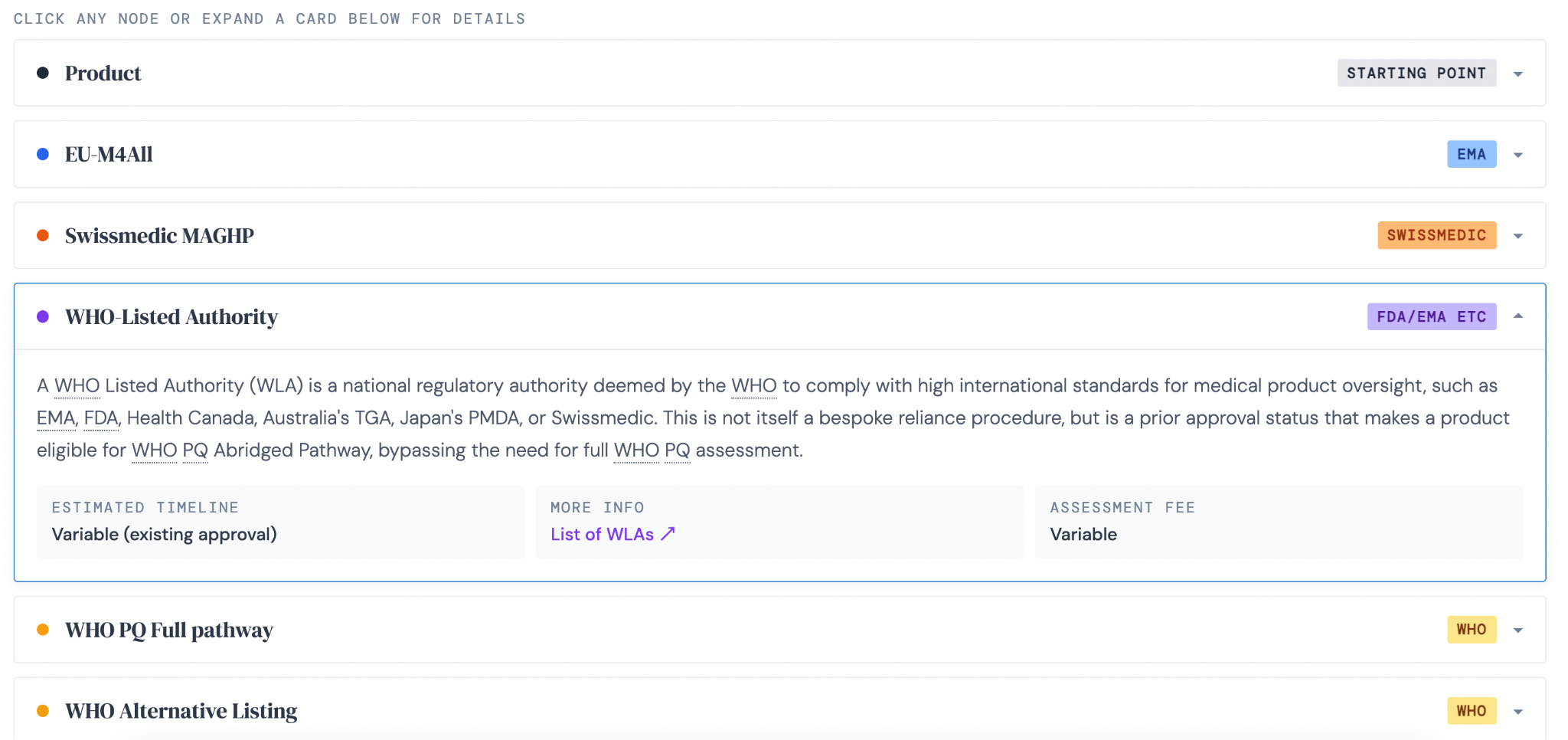
and learn more about each reliance method by expanding the cards at the bottom of the page
The tool is very much an introduction to the regulatory reliance landscape and does not capture every nuance (there are many). But I hope it will be a helpful starting point for anyone thinking about how to get life-saving medicines to the countries that need them most as quickly as possible.
Please feel free to notify me via enlli@clinicaltrialsabundance.blog if you come across any errors, or have any feedback on how I can improve the tool. Thank you in advance for your time.
Really interesting resource. “Google Maps for medicine” caught my attention right away because I’ve been building something similar for rare diseases, which sent me down the rabbit hole that became RareGap: https://raregap.ai/
What I find especially interesting is that we ended up with two very different products using the same map metaphor.
RareGap tries to map a path from a rare disease to biological interventions worth testing.
This maps the path from a medicine to approval in a specific country.
We are tackling two completely different parts of the medicine lifecycle, but surprisingly we have similar ways of thinking about the problem.