

It can take years for a new medicine approved in one country to become available elsewhere. In sub-Saharan Africa, there is typically a delay of 4 to 7 years between a product’s first regulatory submission, usually to a regulator in a high-income country, and its final approval in the region. Part of the reason is that regulators around the world often duplicate each other’s work, conducting the same reviews of the same product.
But last week the FDA announced a new Global Reliance Disclosure Program (GRDP), which could shorten that timeline by making it easier for regulators in other countries to access the FDA’s assessments of the drugs they’re reviewing.

Source: FDA History Office
What is regulatory reliance?
Regulatory reliance is when a regulatory agency in one country takes into account evaluations done by another, while remaining responsible for its own decision.1 The World Health Organization defines it as follows:
“The act whereby the regulatory authority in one jurisdiction takes into account and gives significant weight to assessments performed by another regulatory authority or trusted institution, or to any other authoritative information, in reaching its own decision. The relying authority remains independent, responsible and accountable for the decisions taken, even when it relies on the decisions, assessments and information of others.” (WHO, Good Reliance Practices, 2021)
Reliance can be used by both high- and low-resourced regulators to accelerate review timelines by reducing duplication in the review process. It can be used along the entire regulatory review process. In the context of clinical trials, reliance can be used to streamline clinical trial reviews, especially of more standardised documents such as the study protocols and quality of the investigational medicinal product. The African Vaccine Regulatory Forum (AVAREF) is an example of a network of agencies practicing reliance to accelerate clinical trial approvals across Africa.
It’s a very useful practice for improving patient access, and is consequently considered a 21st century best regulatory practice. The approval of lenacapavir—a new antiviral that has nearly 100% efficacy in preventing HIV infections—in just 12 days by Zambia and 18 in Zimbabwe is a great example of regulatory reliance working well.
However, regulatory reliance is not being utilised to its full potential, especially by lower-resource countries. A recent analysis of regulatory review models across four African regulators found that they all conducted assessments from scratch more often than using reliance. For example, in 2024 Ghana conducted 1570 full assessments compared to just 50 abridged assessments (i.e., using reliance). There are several barriers to regulators using it, which I won’t go into here, but one of the main barriers cited by countries who want to practice reliance is that there are delays in reference regulators sharing assessment reports and supporting documents with relying agencies.
This is why I, and other regulatory policy wonks, became excited last week at the FDA’s announcement of its new Global Reliance Disclosure Program (GRDP), which at least on the surface looks like a very positive step in reducing one of the main barriers to reliance. We don’t have a great deal of information about the program yet, so this blog will provide context on why it’s important, what it could change, and what the most pressing outstanding questions are.
Supportive documents for reliance
A regulatory agency that wants to practice reliance generally needs a range of documents to be provided by the reference regulator. These include:
Certificate of Pharmaceutical Product (CPP): An official certificate issued by a regulatory agency which provides information about the drug’s marketing status and the manufacturer’s compliance with the agency’s requirements. These certificates are part of the WHO Certification Scheme on the Quality of Pharmaceutical Products Moving in International Commerce to support reliance. Participation in the scheme is voluntary.
Evidence of Good Manufacturing Practice (GMP) compliance: This can come in the form of a separate GMP certificate or be included as part of the CPP.
Evidence of approval: Often in the form of an approval letter.
The original dossier sent to the reference agency (full CTD dossier).
The reference agency’s assessment report (public and/or unredacted).
Below is a chart of the documents provided as part of reliance applications using the EMA as a reference regulator:
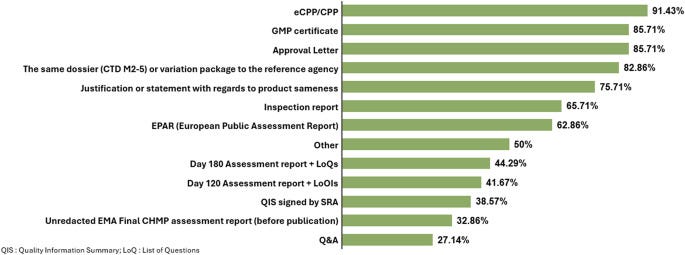
Source: Poulard et al., 2025
As you may have guessed, some regulatory agencies are better at sharing these documents than others. The FDA has frequently been criticised for not being transparent enough with its documents, whereas agencies like the European Medicines Agency (EMA) are considered the gold standard for transparency. These criticism largely pertain to the sharing of assessment reports. There are legislative (and other) reasons why some countries are more transparent about their reports than others, but I won’t go into that here.
How the EMA does it
The EMA is one of the agencies most frequently referenced by regulators practicing reliance, due in large part to its excellent transparency practices. As such, it might be helpful to look at what the EMA does and compare it to how the GRDP is described.
The EMA uses two main routes for sharing its assessments which are then used by relying agencies. Firstly, it publishes a public European Public Assessment Report (EPAR) on its website for every human medicine it approves. The EPAR is a transparent account of EMA’s review alongside the data generated by the applicant. Confidential information is redacted.
Secondly, it shares unredacted assessment reports with other regulators either directly or via the applicant.
Direct exchange (reference regulator → relying regulator):
If a confidentiality agreement is in place, the EMA can share an assessment report with another regulator with no further paperwork.
If there’s no confidentiality agreement, the EMA will still share its assessment report unredacted, but it needs to request the applicant’s consent.
Exchange via applicant (reference regulator → applicant → relying regulator):
The applicant can share the EMA’s assessment report, but they’re fully responsible for any liabilities concerning disclosure of information (especially the redaction of personal data and commercial information). The EMA asks applicants to report on this annually.
There is also the OPEN framework which allows OPEN partners (non-EU regulators with permanent agreements with the EU) to exchange information and participate in EMA’s scientific evaluations for high-priority products.
What the FDA did before
As I noted before, the FDA isn’t known for its transparency. Prior to the GRDP, the FDA shared its assessment in four ways:
Public action packages published on Drugs@FDA: Under section 916 of the FDA Amendments Act of 2007 (21 U.S.C. § 355(l)), action packages for approved original NDAs and BLAs for new active ingredients must be posted online within 30 calendar days of approval. These are public, so trade secrets and confidential commercial information must be redacted first, and the redactions can be substantial. Despite the legal requirement, action packages often appear slowly on FDA’s website, particularly since FDA’s staffing disruptions.
Confidential regulator-to-regulator sharing. FDA can share non-public information with foreign agencies under 21 CFR 20.89, but only within a formal framework. Even where a cooperative arrangement exists, FDA cannot share non-public information unless a Confidentiality Commitment is in place. These commitments exist mainly with well-resourced regulators, such as the UK’s MHRA and Japan’s PMDA. Lower-resource countries without such a commitment depend largely on the redacted public version.
Special programs. FDA’s Oncology Center of Excellence started Project Orbis in May 2019 so international partners could receive and review oncology applications at the same time as FDA. Each partner has a confidentiality agreement in place with the FDA.
FOIA requests. Anyone, including the company, can request records under FOIA, but this is the slow, general-purpose route.
What the GRDP affects is how the FDA shares its assessment reports. They already share a CPP (sent directly to the relying regulator following a request to the FDA), evidence of GMP compliance (included as part of the CPP), and an approval letter (published on Drugs@FDA as part of the approval package).
What will the GRDP do?
While the FDA announced the GRDP program on November 17, according to its press release, it actually launched on October 30, with a President’s Emergency Plan for AIDS Relief (PEPFAR) tentative approval for lenacapavir (remember the intro…).
At present, the GRDP is only available to PEPFAR tentative approvals (excluding tentatively approved abbreviated new drug application products), but the FDA is planning on expanding it to all novel drug and biologics in the new year. The press release also mentions that the “FDA also intends to launch a pathway in early 2027 to expedite an applicant’s ability to request their minimally redacted action packages for approved and licensed drugs and biologics”—which is a bit too vague to make any guesses about.
With respect to the GRDP process itself, the FDA describes it as follows:
“To receive a minimally redacted application approval package as part of the GRDP, applicants must request to participate within 10 calendar days of approval and confirm the application package is being submitted to a foreign regulatory authority in support of a marketing application. Applicants with eligible GRDP applications will receive detailed information in FDA approval letters and the agency intends to provide the minimally redacted package on an expedited basis. Requests for minimally redacted approval packages for other purposes will not be processed under the GRDP and should be submitted as a Freedom of Information Act (FOIA) request.”
So in short, the FDA will share minimally redacted approval packages directly with companies, who can then pass them to regulators outside the US. This new sponsor-mediated route implies the FDA will no longer need a confidentiality agreement with each country.
Furthermore, packages are described as “minimally redacted”, which suggests an improvement on the public action packages, however, the press release doesn’t say exactly what will still be removed, so the scale of the practical gain isn’t yet clear (see Outstanding Questions below). Finally, the implied removal of confidentiality agreements alongside the stated “expedited basis” for sharing assessments will likely result in a much faster process for relying regulators to access these documents.
Final thoughts and outstanding questions
While the FDA’s GRDP does not reach the gold standard of the EMA in my view, it is a significant milestone and worth celebrating. The FDA is central to reliance. Of new drugs approved between 2014-2018, 70% were submitted to the FDA first, which is why people have been so frustrated by its lack of transparency in the past, and why this new program is so welcome. As always, the proof will be in the pudding, and I will be tracking this pudding eagerly.
I’m certain we will learn more about the GRDP in due course, especially when the program expands its scope in the new year. But in the meantime, my immediate questions about the program are the following:
What does “minimally redacted” mean?
How will the two requirements to be a part of the GRDP—(i) must request to participate within 10 days of approval, and (ii) confirm the application is being submitted to a foreign regulatory authority—impact developers?
Will there be a committed target timeline for “expedited basis”?
As always, please feel free to reach out to me at enlli@clinicaltrialsabundance.blog if you would like to discuss this topic or share some of your own questions about the program.
In this blog, I will be calling regulators who are being relied upon “reference regulators”, and regulators who take into account the assessment of another regulator “relying regulators.”
How big of a problem is reliance relative to sponsor concerns about parallel trade, IP concerns, or just inability to pay in low resourced regions? This is not an objection at all, just a question about how programs like GAVI, PEPFAR, or patent pools can be leveraged to encourage sponsors to sell drugs in more low income countries.